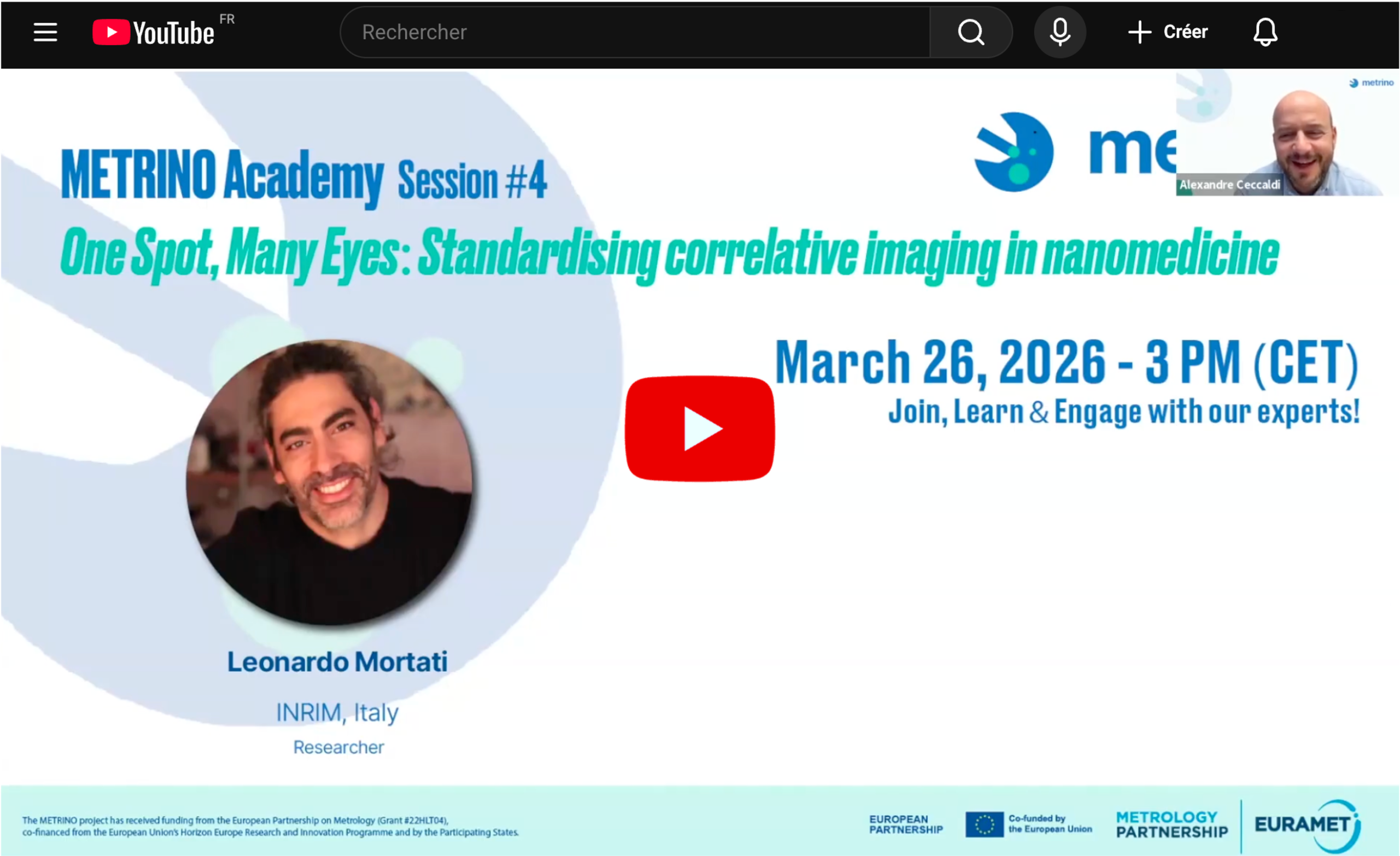
REPLAY: METRINO Academy Session 4 “One Spot, Many Eyes”
From nanoparticles images to trustworthy evidence
Nanoparticle biodistribution studies can produce visually striking data. But in practice, it is much harder to know whether the signal seen in tissue is truly robust, chemically meaningful, and comparable across methods or laboratories.
That is exactly where METRINO Academy Session 4 placed the discussion.
Led by Leonardo Mortati of INRiM and moderated by Alexandre Ceccaldi of ETPN, the webinar focused on a practical question with major implications for translation: how do we make nanoparticle biodistribution evidence more trustworthy?
Held on 26 March 2026, this session explored how correlative imaging can move beyond isolated, case by case imaging attempts and become a more standardised workflow for nanomedicine, bringing together methods including Nonlinear Optical Microscopy, Raman Microscopy, Fluorescence Microscopy,
SEMScanning Electron Microscopy,
EDXEnergy Dispersive X-ray Spectroscopy,
ToF-SIMSTime-of-Flight Secondary Ion Mass Spectrometry,
and
LA-ICP-MSLaser Ablation Inductively Coupled Plasma Mass Spectrometry.
The key message was clear throughout the session: what we need is a correlative workflow to make nanomedicine more robust, comparable and trustworthy.
Missed the live session?
Watch the recording
We are pleased to share that the full recording of METRINO Academy Session 4 is now available. If you could not attend live, or if you would like to revisit the presentation and Q&A, you can now access the replay here.
With 55+ registered participants and an overall satisfaction score of 8.5/10 from respondents, the session clearly addressed a topic that resonated with the community. This session will be especially useful for researchers working on biodistribution, tissue imaging, nanoparticle tracking, or advanced characterisation workflows. It combines conceptual clarity, real examples from the METRINO project, live polls, and a Q&A that stayed close to practical research questions.
Words from the expert
“To ensure safety and efficacy, we must understand what happens to these nanoparticles when they are in vivo.”
Leonardo Mortati, Researcher, INRiM
Leonardo framed the challenge in direct and practical terms. Biodistribution is not only about detecting nanoparticles. It is about understanding where they are, how much is there, what chemical form they are in, and what biological environment surrounds them. That is precisely why correlative imaging matters.
“Correlative imaging could be a powerful solution, because it can integrate multiple techniques and combine the strengths of these different methods to have a more complete picture of the sample.”
Rather than presenting correlative imaging as a list of advanced instruments, the session showed why it must be approached as a workflow, one that depends on sequence, calibration, sample preservation, and careful comparison between outputs.
A key takeaway from the session: sequence matters
One of the strongest practical takeaways from the session was that correlative imaging is not only about method choice. It is also about method order.
Leonardo described a workflow that starts broad and minimally invasive, then progresses towards more analytical and more destructive methods. Wide field optical microscopy can help identify the relevant area first. Non destructive techniques such as nonlinear optical microscopy, Raman, and fluorescence microscopy can then be used while preserving the sample as much as possible. He also explained that SEM and EDX may fit within this earlier part of the workflow, although sample treatment must be considered carefully. More destructive methods such as ToF-SIMS and LA-ICP-MS come later, once the earlier information has already been captured.
As Leonardo put it during the Q&A: “The first analysis should be the less invasive possible.“
This logic is one of the clearest examples of the practical value of the replay: the session does not simply name techniques, it explains how to think about combining them.
One practical checkpoint from the session
If you want a quick way to apply the logic of the webinar to your own work, this checklist captures one of the session’s most useful contributions.
Correlative imaging checklist
A practical framework inspired by METRINO Academy Session 4
1. What do you need to know? Localisation, quantification, chemical speciation, tissue context, or several of these at once?
2. What can your sample tolerate? Live, fixed, sectioned, coated, partially destroyed?
3. Which sequence preserves the most information? Start broad and non-destructive, then move towards more analytical and more destructive methods.
4. How will you compare the outputs? Region of interest (ROI) alignment, calibration, traceability, and consistent acquisition settings are not optional.
Practical checkpoint
Common traps to avoid
Correlative imaging can become very powerful, but only if the workflow stays disciplined. These are some of the recurring pitfalls highlighted during the session.
Changing settings without calibration
Shifting acquisition parameters from one sample to another may improve contrast, but it weakens quantitative comparability.
Assuming one signal equals one truth
Different techniques may reveal different aspects of the same sample, not the same information in a different format.
Comparing different ROIs
If outputs do not refer to the same region of interest, agreement or disagreement can become misleading.
Treating sample preparation as neutral
Preparation choices can shape what remains measurable and what becomes distorted or lost.
Q&A highlights
The Q&A brought an especially useful dose of realism to the session. Rather than treating correlative imaging as a polished finished solution, Leonardo helped clarify where the workflow is already strong and where laboratories still need to proceed carefully.
The answer was clear: alignment.
Matching data across techniques remains one of the hardest practical challenges because methods differ in scale, resolution, sample depth, and signal type. In some cases, alignment can be supported algorithmically. In others, it remains manual, time consuming, and difficult even for experienced users.
One of the strongest practical warnings from the session concerned acquisition settings.
If the goal is quantitative comparability, laboratories should avoid changing parameters from one experiment to another simply to optimise contrast, unless those changes are themselves calibrated and controlled. Otherwise, the result may still look convincing, but it becomes much harder to interpret quantitatively. As Leonardo stressed: “If you change a lot the parameters, you can detect, but you cannot think about quantitative measurements.”
This was one of the most reusable lessons of the whole webinar.
Leonardo’s answer was balanced and encouraging.
Correlative imaging is not yet an easy routine workflow for every lab, mainly because the techniques involved are costly, technically demanding, and not always available in one place. But it is not out of reach either. For many laboratories, collaboration will be the most realistic entry point, and as Leonardo put it, “it’s not impossible. We are showing that, actually, it is possible.”
Why this session matters for METRINO
Session 4 marked an important step for METRINO. It showed how the project’s standardisation mindset can also be applied to imaging based analysis, where the challenge is often not just acquiring images, but knowing how much trust to place in what they show.
That point clearly resonated with the audience. In the final live poll, 84% of the respondants said they would be likely to use a standardised workflow for correlative imaging if practical guidance were available.
If you would like to explore these points in more detail, the full replay is now available and well worth watching, especially for the practical examples, the workflow logic, and the Q&A discussion on alignment, quantification, and uptake.
More broadly, this session also fits into the larger trajectory of the Academy series. Across the past sessions, METRINO has progressively built a more practical metrology culture for nanomedicine, moving from manufacturing reality and method selection towards interlaboratory comparability and, now, spatially resolved tissue level evidence.
That progression matters because the challenge is no longer only how to characterise nanomedicines in vitro. It is also how to support preclinical interpretation with workflows that remain interpretable, reproducible, and comparable across laboratories.
With that same ambition in mind, the next session will turn to another key layer of nanomedicine characterisation: surface chemistry.
What’s next
METRINO Academy Session 5: “Unlocking Surface Chemistry in Nanomedicine”
Thursday, 23 April 2026, 15:00 CET
The final session of the METRINO Academy will turn to another key challenge in nanomedicine characterisation: surface chemistry.
If Session 4 focused on building more trustworthy tissue level evidence through correlative imaging, Session 5 will explore how better understanding and characterising surface chemistry can support more robust manufacturing, interpretation, and reproducibility.
Why surface chemistry is critical for nanomedicine performance and reproducibility
How better characterisation can support more robust manufacturing and quality control
What practical challenges remain when analysing functional groups and coatings
How METRINO is helping turn complex surface characterisation into more usable guidance
Speaker will be Dr Ute Resch-Genger, with moderation from Alexandre Ceccaldi. More information here.
About the METRINO Academy
A short webinar series designed to translate METRINO outcomes into practical, user oriented guidance for the broader community, with a focus on real life decisions such as quality control, reproducibility and standardisation readiness.
If you missed the previous sessions, you can also revisit the replay articles for:
The METRINO project has received funding from the European Partnership on Metrology (Grant #22HLT04), co-financed from the European Union’s Horizon Europe Research and Innovation Programme and by the Participating States. Views and opinions expressed are however those of the author(s) only and do not necessarily reflect those of the European Union or EURAMET. Neither the European Union nor the granting authority can be held responsible for them.
We use cookies to ensure that we give you the best experience on our website. If you continue to use this site we will assume that you are happy with it.