
Building trust in RNA-LNP analytics across laboratories
RNA loaded lipid nanoparticles are central to today’s mRNA and siRNA therapeutic pipelines, but their analytical characterisation is still far from harmonised. Results can shift from one laboratory to another not only because of instrumentation, but also because of differences in sample preparation, measurand definition, data treatment, and reporting choices.
On 5 March 2026, METRINO Academy Session 3 brought the community together for a practical and metrology-driven discussion on how to make RNA-LNP measurements more trustworthy, comparable, and transferable across laboratories. The session featured Enrica Alasonati of LNE and Jérémie Parot of SINTEF, moderated by Alexandre Ceccaldi of ETPN.
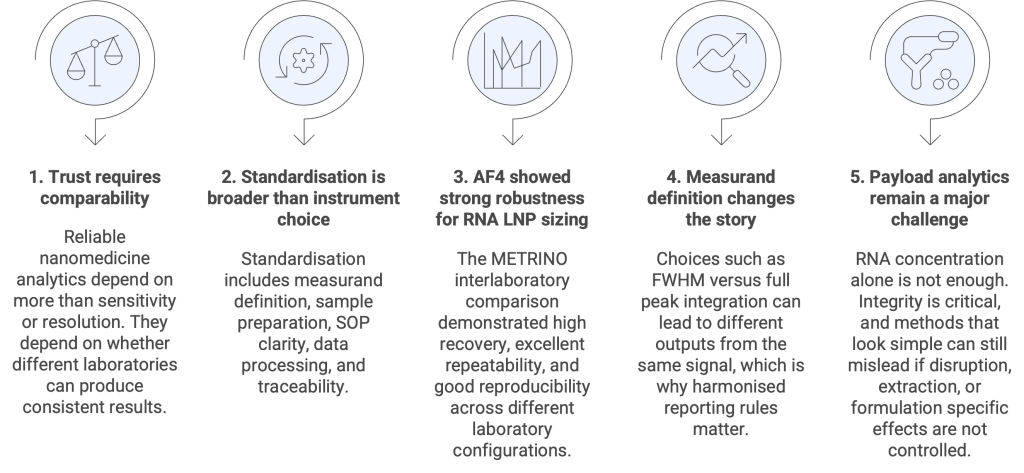
The central message was clear from start to finish: trust requires comparability.
Rather than treating standardisation as a matter of selecting the right instrument, the speakers showed that reliable analytics depend on a broader chain of decisions. It means aligning not only the method, but also the measurand, the sample handling, the data processing rules, and the level of reproducibility needed for results to hold across sites. That logic sits at the heart of METRINO’s work on validated methods, SOPs, and future standardisation pathways for nanotherapeutics.
Missed the live session?
Watch the recording
We are pleased to share that the full recording of METRINO Academy Session 3 is now available. If you could not attend live, or if you would like to revisit specific moments from the talks and Q&A, you can now access the replay here.
This session is especially useful for researchers and developers working on RNA-LNP formulation, analytical characterisation, or quality control. It combines interlaboratory evidence, practical analytical insight, live polls, and audience questions around some of the most common pain points in the field.
A highly engaged audience for a topic that clearly matters
This third METRINO Academy session once again confirmed how strong the need is for practical guidance on nanomedicine analytics.
15+ countries represented
80% of participants from academic institutions, alongside participants from industry and metrology institutes
8.8 / 10
Average satisfaction rating
1h 11m
Average watch time
from Zoom Analytics, over a total duration of 1h20 before editing
4 live polls
Capturing real world concerns throughout the session
The poll results reinforced one of the session’s strongest messages: interlaboratory variability is rarely caused by one single issue.
When participants were asked what most often drives differences across laboratories, the most frequent answers were sample preparation and handling and incomplete materials and methods reporting. Instrument settings, SOP clarity, operator training, standards, and data processing choices were also widely selected. The overall picture was clear: disagreement across labs is not one bottleneck, but a system of interacting variables.
The first poll also revealed an important gap between what is measured routinely and what matters biologically. Many participants reported working routinely on size, concentration, and morphology, while RNA integrity appeared much less established in everyday practice. That made the payload discussion especially timely, because as Jérémie reminded the audience, for RNA payloads one break can mean no effect.
Words from the experts
“Sometimes we put a lot of energy into high resolution instrumentation, but trust comes from independent labs getting consistent results.”
Enrica Alasonati, Senior Scientist, LNE
Enrica brought the metrology backbone of the session. Her talk showed how comparability is built through rigorous harmonisation of methods, workflow, and data treatment, and why standardisation must go beyond naming a technique to clearly defining the measurand itself. Her examples made one point especially tangible: even when laboratories work on the same sample, the final answer can shift depending on how the signal is treated and interpreted.
“RNA concentration may look easy at first, but it remains a challenge in the field.”
Jérémie Parot, Senior Research Scientist, SINTEF
Jérémie complemented this with the analytical reality of RNA-LNP workflows. Starting from the perspective of developers and analytical laboratories, he showed why RNA-LNP characterisation quickly becomes complex, with many critical quality attributes to consider across formulation, sizing, concentration, purity, and integrity.
His discussion of payload analytics was especially valuable. Fluorescence based methods may appear simple and accessible, but they can become misleading when LNP disruption is incomplete or formulation dependent. They may also say nothing about RNA integrity. Capillary gel electrophoresis can provide richer information, but introduces its own challenges around extraction, complexity, matrix effects, and interpretation.
His most memorable warning came during the Q&A:
“Batch DLS is the tip of the iceberg.”
Taken together, the two talks converged on a strong shared message. Standardisation is not about reducing complexity to one number. It is about making complex measurements interpretable, reproducible, and defensible.
The clearest demonstration came from the METRINO interlaboratory comparison itself.
The interlaboratory comparison at the heart of the session
A central highlight of the webinar was the METRINO interlaboratory comparison on RNA-LNP sizing using multi detector AF4 with light scattering.
The message was not that one advanced instrument alone creates confidence. The real impact came from showing that independent laboratories could obtain coherent results under harmonised conditions, and that those results could be assessed through an explicitly structured interlaboratory exercise.
The design was deliberately rigorous, involving 10 participants from NMIs, research organisations, instrument manufacturers, and CROs, with two suppliers, two channel types, one harmonised AF4 MALS/DLS method, two complementary techniques, and a dedicated stability study running in parallel.
Samples were shipped at 4°C, participants had two weeks to analyse them, and separate stability monitoring was carried out at 4°C and -20°C. Most importantly, the exercise delivered strong analytical performances:
These are meaningful results for fragile and complex objects such as RNA-LNPs. As Enrica stressed during the Q&A, this degree of reproducibility is a strong and realistic benchmark for this kind of material.
Why this matters: the session also showed that even under strict harmonisation, the final answer still depends on how the measurand itself is defined. The comparison between full width at half maximum and full peak integration captured this perfectly: the same signal can lead to different reported values depending on how it is processed and interpreted.
The webinar also highlighted why fractionation is so powerful in this context. Beyond giving access to size and size distribution, AF4 enables online separation of LNPs from the matrix, which is especially valuable because it can avoid more invasive extraction steps that may themselves transform the sample.
This does not necessarily make AF4 the first line routine method in every laboratory, but it clearly positions it as a highly valuable state of the art approach for in depth RNA-LNP characterisation.
What comes next: these results are intended to feed ongoing standardisation activities and will also be described in more detail in a future publication, making the full interlaboratory dataset and analysis more widely accessible to the community.
One key message from the Q&A
The Q&A brought an important dose of realism to the discussion.
Participants asked what remains possible when you are not part of a large EU metrology project, how to choose extraction methods, when fractionation is worth the effort, and what to do when measurements shift in serum or plasma. The answers consistently pointed in the same direction: comparability culture needs to grow beyond individual projects.
That means more than just publishing methods. It means moving towards reference materials, proficiency testing structures, and more routine collaboration between developers, analytical labs, and national metrology institutes.
The Q&A also highlighted a crucial open question for the field: if physicochemical properties appear reproducible but biological effects still vary, are we really measuring the right parameters yet? Surface properties, internal structure, and biological assay reproducibility all emerged as areas where further metrology work is still needed.
Take home messages
If you would like to explore these points in more detail, the full replay is now available.
METRINO Academy Session 4: “One Spot, Many Eyes: Standardising Correlative Imaging for Nanomedicine”
Session 4 will explore how correlative imaging can support more robust nanomedicine characterisation. As imaging becomes increasingly important for understanding complex nanomaterials in biological environments, the challenge is no longer only to generate compelling images, but to align results across techniques, laboratories, and workflows in a way that supports confidence and comparability.
- Why correlative imaging is becoming increasingly important for nanomedicine characterisation
- The challenge of comparing and aligning imaging results across techniques and laboratories
- How standardisation can improve data quality, interpretation, and confidence in imaging based analysis
- What is needed to move from promising images to more robust and transferable measurements
Speaker will be Leonardo Mortati (INRiM), with moderation from Alexandre Ceccaldi. More information here.
About the METRINO Academy
A short webinar series designed to translate METRINO outcomes into practical, user oriented guidance for the broader community, with a focus on real life decisions such as quality control, reproducibility and standardisation readiness.
If you missed the previous sessions, you can also revisit the replay articles for Session 1 on the industrialisation of nanomedicines with Nanobiotix and Session 2 on choosing the right measurement method.
Join our growing METRINO community on LinkedIn and connect with researchers, industry and regulators working on nanomedicine metrology.
