
A practical pain point of nanomedicine tackled in the METRINO Academy
Nanomedicine characterisation can feel deceptively simple. Ask for “particle size” and you will often get several correct answers that do not match. Each method measures a different measurand, each comes with assumptions, and complex matrices can quietly distort results.
On 5 February 2026, METRINO Academy Session 2 brought the community together for a practical, metrology-oriented guide to analytical method selection, led by Dr Christian Gollwitzer (PTB) and Prof Yuri Antonio Diaz Fernandez (University of Pavia) and moderated by Dr Alexandre Ceccaldi (ETPN). Through real METRINO case studies, the session unpacked how to choose techniques based on what you need to know, what your sample can tolerate, and how confident you need to be in comparability.
A core message framed the discussion early: without uncertainty, you cannot truly compare results.
Together, the speakers showed that method selection starts well before you open an instrument. It begins with defining what you want to measure, what you are measuring it in, and what level of confidence you need in the result.
Missed the live session?
Watch the recording
We are pleased to share that the full recording of METRINO Academy Session 2 is now available. If you could not attend live or you want to revisit specific parts, you can access the replay here.
Whether you work in academia, industry, or a metrology institute, the replay is designed to be practical. It combines real examples, live polls, and a Q&A focused on common lab situations where results become difficult to interpret.
A highly engaged audience for a lively session
What made this session stand out was the level of interaction. The strong engagement around this METRINO Academy session confirmed the importance of this topic for the nanomedicine community :
10+ countries
International participation, 75% from Academic Institutions, 15% from Industry
9.5 / 10
Average satisfaction rating
100%
Satisfaction survey respondants certain to attend the next session
1h 15m
Average watch time
from Zoom Analytics, over a total duration of 1h23 before editing
The audience responses to the live polls confirmed a reality of nanomedicine research and development : method choice is rarely the bottleneck alone. It is the combination of sample preparation, interpretation, and comparability that makes characterisation hard, as highlighted by the poll results to the question What is currently your biggest challenge in nanomedicine characterisation:
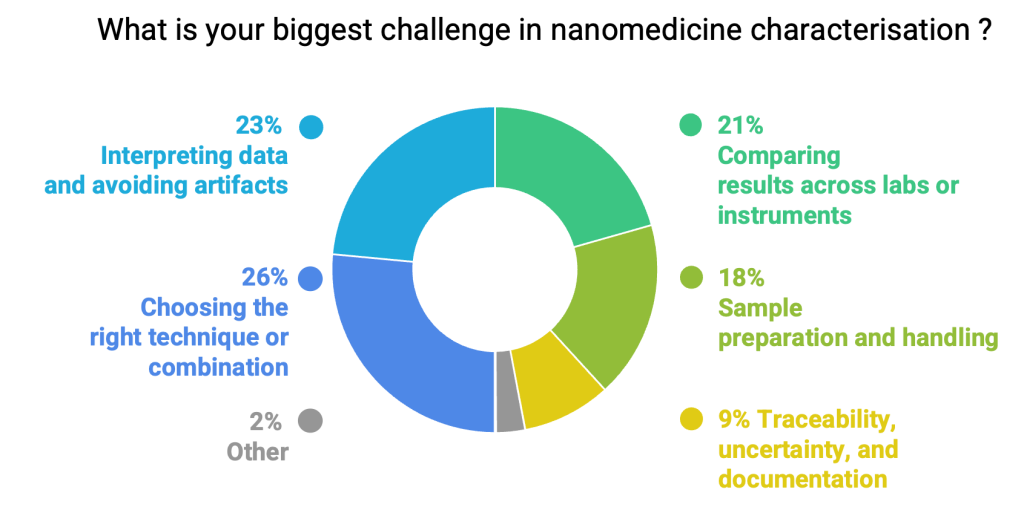
The live polls showed that challenges are not concentrated in one step. They span sample preparation, technique selection, data interpretation, comparability, and traceability. The discussion around this poll is particularly worth watching in the replay.
Words from the experts
“In order to decide if the measurements are comparable or if they are correct, you need the uncertainties.”

Dr Christian Gollwitzer, Head of Working Group “X Ray Radiometry”, Physikalisch Technische Bundesanstalt (PTB)
Christian anchored the session in a metrology reality-check. Using a reference particle example measured across multiple instruments and institutes, he showed how easy it is to end up with several plausible values that cannot be judged on the number alone. His key point was simple and decisive: uncertainty is what turns a result into something you can compare.
“Sometimes people ask for size, but they really do not know what they are asking for.”
Prof Yuri Antonio Diaz Fernandez, Professor of Microspectroscopy and Bioimaging, University of Pavia
Yuri translated method choice into the language of real development needs. He reminded the audience that “size” is often asked for as a single number, even though it can reflect different physical meanings and different weightings. Through METRINO examples on liposomes and complex media, he showed how sample preparation and matrix effects can shift what an instrument reports. The takeaway was pragmatic: before picking a technique, make sure you know what question you are actually trying to answer.
Taken together, the two talks converged on a shared message. There is rarely a single best technique. What matters is choosing methods that match the measurand, the material, and the decision you need to make, then reporting results in a way that supports comparability.
Take home messages
- Start by defining the measurand.
“Size” can mean core size, geometric size, hydrodynamic size, or a descriptor derived from a distribution. - Do not compare numbers that describe different things.
Disagreement is not always an error. It is often a different measurand. - Uncertainty enables comparability.
Without it, you cannot robustly judge agreement, disagreement, or outliers. - Sample preparation is part of the measurement.
Validate it by comparing techniques that rely on different preparation routes, for example SEM versus cryo TEM. - Biological matrices can quietly bias results.
In protein rich environments, DLS can shift towards smaller values due to matrix scattering and aggregation effects. - Separation can rescue interpretation.
AF4 can decouple matrix contributions from particle signals and restore consistent sizing.
One key highlight from the Q&A
If you want a quick way to apply the session in your own work, this checkpoint captures the logic the speakers returned to throughout the webinar.
- Do not compare hydrodynamic size with core or geometric size
- Do not trust a single number without checking distribution and weighting
- Do not ignore matrix contributions in protein rich media
Method selection is not an instrument choice, it is a thinking sequence. Define the measurand, consider the material and matrix, then decide the level of confidence and comparability you need.
The session highlighted three recurring traps that can create false disagreement: comparing hydrodynamic size with core or geometric size, relying on a single average without checking distribution and weighting, and overlooking matrix contributions in protein rich media.
When two methods disagree, do not pick a winner. Go back to the measurand first, then check weighting, sample preparation, and matrix effects.
Beyond the concepts, the replay includes concrete METRINO examples and the decision tables discussed live. If you want to see how the “right technique” changes with material class and measurand, and how separation techniques can rescue interpretation in complex matrices, the recording will be particularly useful.
Based on the poll results, METRINO WP5 is also working on a new practical decision support tool inspired by the heat map approach discussed live, more details will be shared soon.
METRINO Academy Session 3: “Tiny Particles, Big Challenge : Standardising RNA-LNP measurement across laboratories ”
Session 3 will focus on RNA lipid nanoparticles (RNA-LNP) and the practical challenge of comparing measurements across laboratories. Building on the method selection logic from Session 2, we will explore what it takes to trust results across instruments, sites, and workflows, with a particular emphasis on interlaboratory activities and measurands that matter for LNPs.
- RNA LNP measurement across laboratories: common pitfalls and good practices
- How to assess and improve comparability across labs and instruments
- Key measurands for LNPs: what to measure and why it matters
- Lessons learned from METRINO interlaboratory work
Speakers will be Jérémie Parot (SINTEF) and Enrica Alasonati (LNE). Registration details coming soon.
About the METRINO Academy
The METRINO Academy is a short webinar series designed to translate METRINO outcomes into practical, user oriented guidance for the broader community, with a focus on real life decision making, including quality control, reproducibility, and standardisation readiness.
Join our growing community on LinkedIn and connect with researchers, industry and regulators working on nanomedicine metrology.
Watch the Academy Session #1 on the Industrialisation of nanomedicine, featuring Nanobiotix, here.
