From complex biological matrices to comparable measurements
WP3 developed and evaluated practical workflows for preparing and separating lipid nanoparticles, liposomes and metal oxide nanoparticles in biologically relevant media. By connecting sample preparation with AF4, SEC and SAXS, the work shows how matrix effects, recovery and separation conditions influence measurement quality and comparability across laboratories.
Our results From controlled sample preparation to comparable measurements in complex media
The RNA-LNP interlaboratory comparison
WP3 tested whether independent laboratories could obtain comparable RNA-LNP size measurements when they used a harmonised AF4-MALS/DLS workflow and common reporting rules.
- Two aqueous RNA-LNP formulations representative of Onpattro-type systems were distributed for analysis.
- Ten participants applied the shared workflow across different laboratories and instrument configurations.
- Mean recoveries reached 95% and 96%, comfortably above the 70% performance criterion used in the study.
- Size repeatability was below 2% and interlaboratory reproducibility was below 7%.
Recovery: The proportion of the sample still recovered and measured after the full analytical workflow.
Repeatability: The consistency of repeated results obtained under the same conditions in one laboratory.
Interlaboratory reproducibility: The consistency of results obtained when the same method is applied across different laboratories.
Evidence base: METRINO RNA-LNP interlaboratory comparison, consolidated in D6 and presented in Academy Session 3.

Four connected results
WP3 linked the full analytical chain, from placing nanoparticles in relevant matrices to validating and comparing the methods used to separate and characterise them.
Controlled sample preparation
Practical matrix-spiking and sample-preparation approaches for selected nanoparticles in media ranging from PBS to serum-based and whole-blood model systems.
Fractionation and direct analysis workflows
AF4 and SEC methods for selected LNPs, liposomes and metal oxide nanoparticles, complemented by SAXS measurements directly in biological media.
Interlaboratory evidence
A harmonised RNA-LNP comparison showing strong recovery, repeatability and cross-laboratory reproducibility for size measurements.
Validated protocols and good practice
Protocols, SOPs, performance criteria, limitations and reporting recommendations compiled for future laboratory use and method development.
Sample preparation protocols and good practice guidance
D5 focuses on preparing nanoparticles and matrices before measurement. D6 builds on that foundation with validated fractionation and characterisation protocols, method-performance evidence and practical recommendations.
Protocols for sample preparation and measurement in liquid biological matrices
What will you find in D5?
- Selection of model matrices and nanoparticle systems for method development.
- Spiking protocols designed to limit dilution and matrix interference.
- Extraction and fractionation approaches for metal oxide nanoparticles, liposomes and LNPs.
How can you use D5?
- Plan matrix-spiking studies with relevant controls and concentrations.
- Identify where extraction is needed and where fractionation can separate particles from matrix components directly.
- Anticipate interactions between the sample, matrix and mobile phase.
Validated protocols for AF4, SEC and SAXS measurements
What will you find in D6?
- Validated AF4 and SEC protocols for representative LNPs, liposomes and metal oxide nanoparticles.
- A complementary static SAXS workflow for direct analysis in biologically relevant media.
- Performance evidence covering recovery, precision, carryover, selectivity, resolution and reporting.
How can you use D6?
- Select a method that fits the nanoparticle, matrix and analytical question.
- Plan method-performance checks and report the workflow more completely.
- Adapt the protocols to new systems while preserving their stated scope and re-verifying performance.
From research mobility to shared scientific outputs
A collaboration built around AF4 expertise
During an Erasmus research stay at LNE, Ester Cantoni from the University of Pavia developed asymmetric flow field-flow fractionation strategies for silver nanoparticles and FeraSpin™ R iron oxide nanoparticles. The work connected Pavia’s material expertise with LNE’s measurement and fractionation capabilities, alongside Nantes Université and other collaborators.
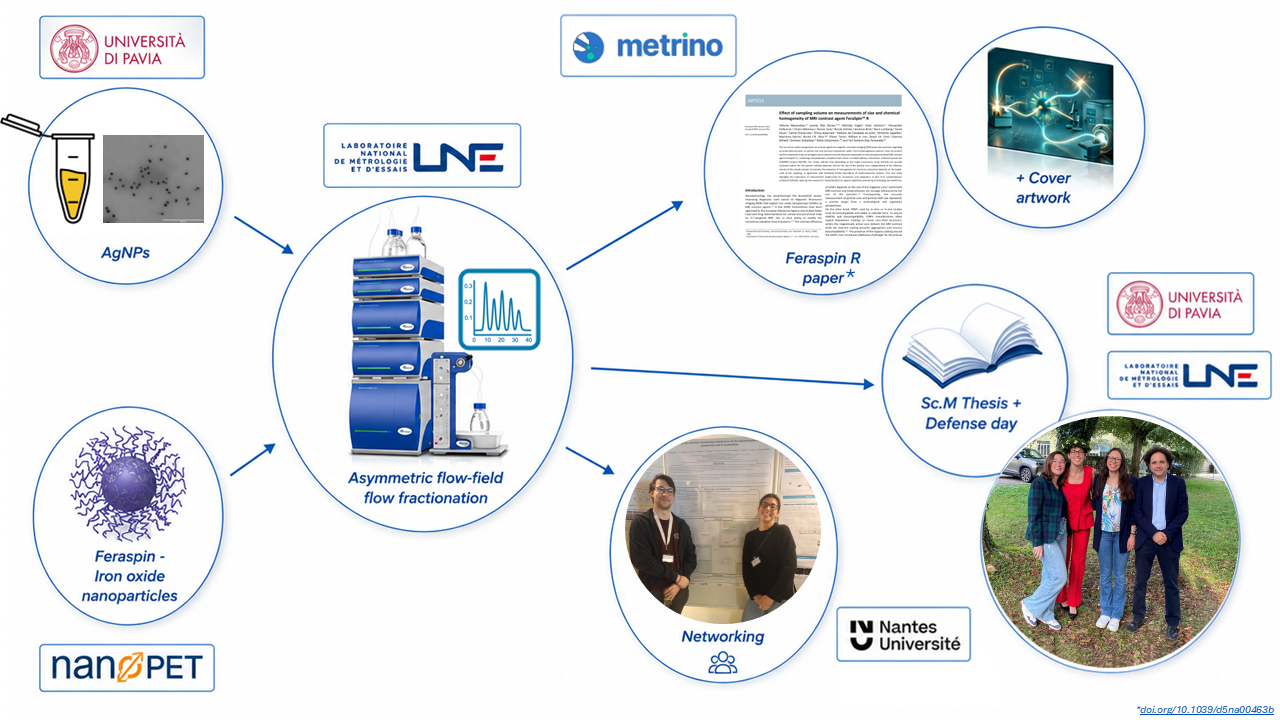
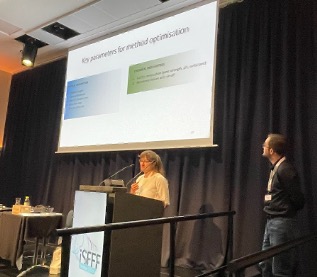
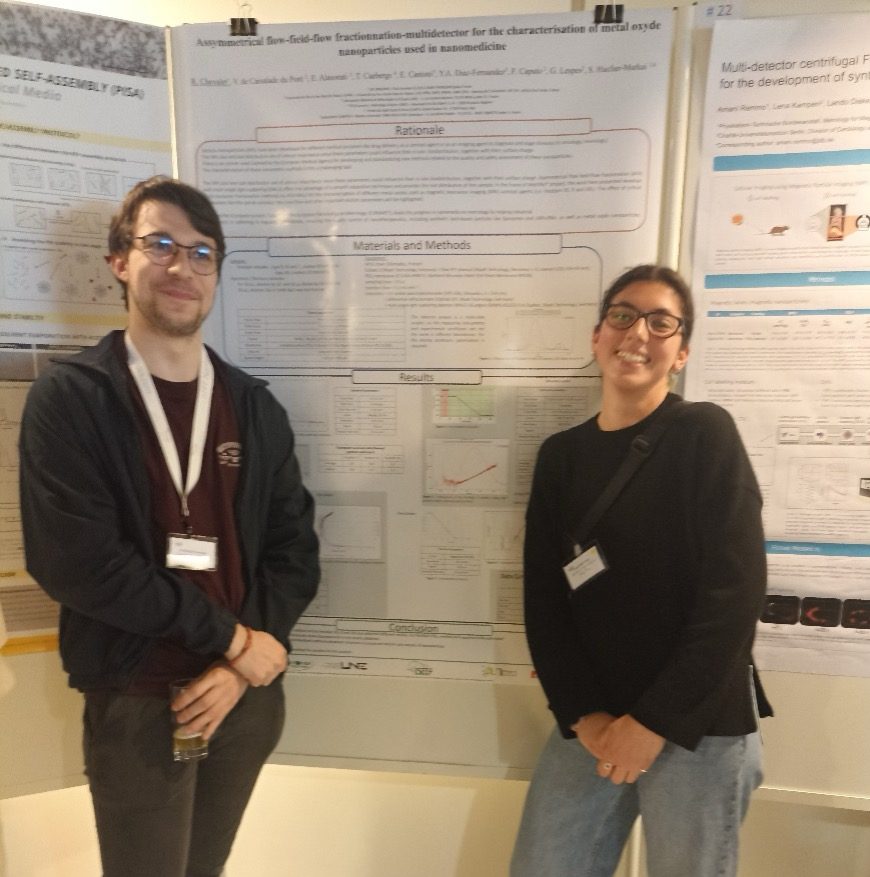
At the 23rd International Symposium on Field- and Flow-based Separations in Nantes in June 2024, LNE presented WP3 work on robust fractionation strategies in biological matrices, while a joint poster shared preliminary iron oxide nanoparticle results developed with Arronax, the University of Pau, SMD, the University of Pavia and LNE.
The collaboration supported Ester’s MSc thesis and contributed to the peer-reviewed article Effect of sampling volume on measurements of size and chemical homogeneity of MRI contrast agent FeraSpin™ R, Nanoscale Advances 8 (2026), 3136–3150. Explore all METRINO publications
Learn from the experts How to build a reliable workflow for measurements in biological matrices
Build the measurement around the nanoparticle-matrix system
WP3 showed that method selection should follow a sequence of practical decisions. The same instrument can produce different answers if the matrix, sample handling or data-treatment rules change.
RNA-LNP analytics makes this chain especially visible. Academy 3 shows why comparability depends on aligning sample handling, method conditions, measurands, data processing and reporting across laboratories.
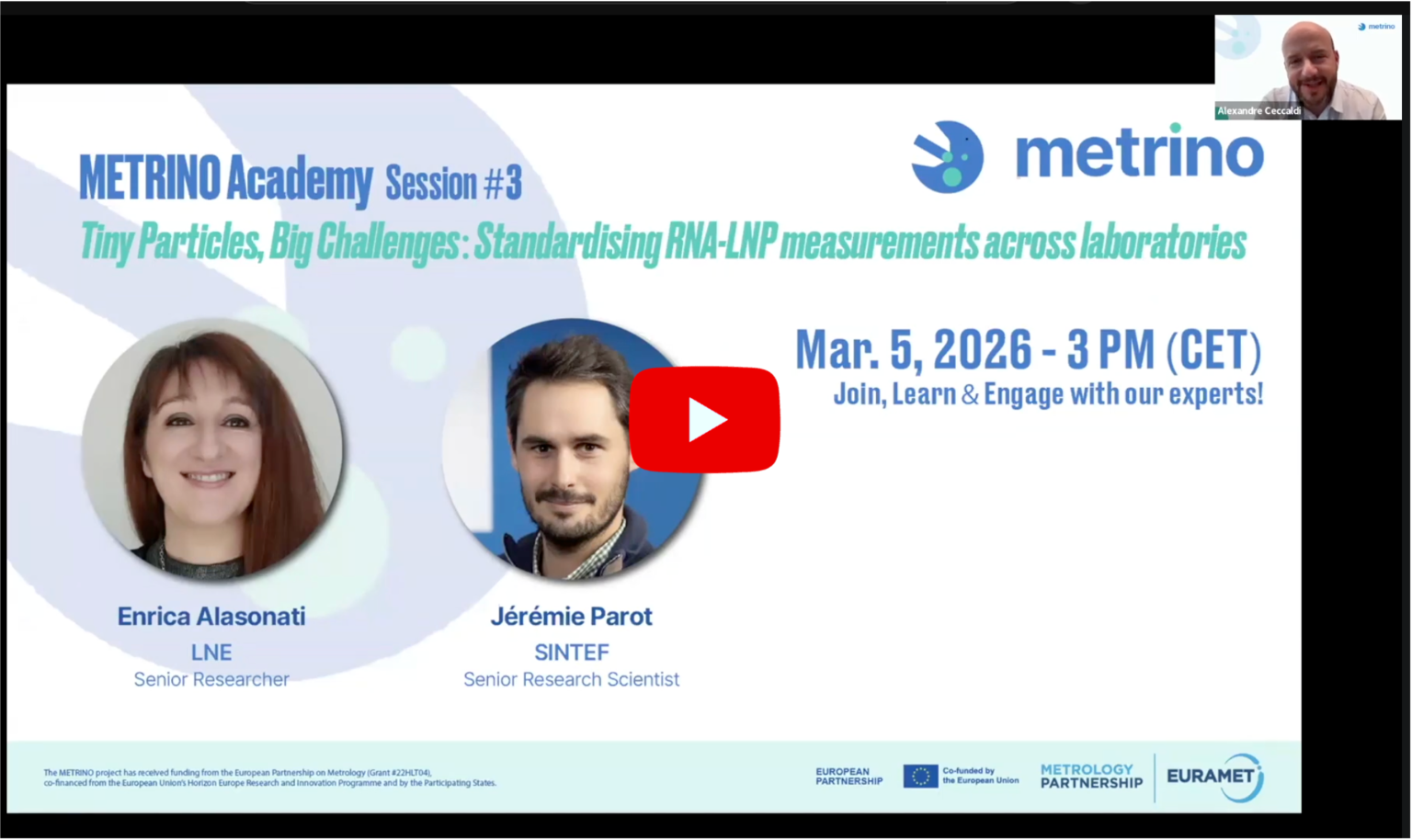
Tiny Particles, Big Challenges: Standardising RNA-LNP Measurements Across Laboratories
Presented by Dr Enrica Alasonati, LNE, and Dr Jérémie Parot, SINTEF.
What you will learn in this webinar
- Why RNA-LNP results can change across laboratories even when the same samples are measured.
- How AF4 workflows, measurands and data treatment were harmonised for the MetrINo comparison.
- How recovery, repeatability and reproducibility support confidence in a method.
“Sometimes we put a lot of energy into high resolution instrumentation, but trust comes from independent labs getting consistent results.” Dr Enrica Alasonati, MetrINo Academy Session 3
What WP3 taught us Why comparability depends on the full analytical workflow
Nanoparticles can change when they enter a biological matrix, while the matrix can interfere with their detection and separation. WP3 therefore treated sample preparation, fractionation, direct analysis and data interpretation as one connected measurement problem.
From matrix effects to practical lessons
Proteins, salts and other components can affect colloidal stability, scattering background, retention behaviour and detector response.
A workflow that performs well in buffer cannot be assumed to work unchanged in serum or another complex medium.
Low recovery can reveal particle loss, adsorption, matrix interference or disruption during separation.
Users need to know how much analyte reached the detector and whether the workflow altered the sample.
Peak boundaries, full-peak or FWHM integration and measurand definitions affect size and recovery values.
Harmonisation must cover the full route from sample to reported result, not only the instrument settings.
Fractionation can resolve populations, while SAXS can probe selected systems directly in their surrounding medium.
The method should follow the particle, matrix, concentration and decision, with complementary evidence used where needed.
From results to community use Practical routes to apply, teach and extend the WP3 workflow
Three ways to use and extend the WP3 results
- Apply the workflow, not only the instrument settings. Use D5 and D6 to plan sample preparation, matrix controls, recovery checks, method validation and complete reporting.
- Train teams around comparability. Use the RNA-LNP comparison and Academy replay to show how measurand definition and data treatment affect results across laboratories.
- Build the next comparisons and guidance. Extend the approach to additional nanotherapeutics, matrices and instrument configurations, while keeping the validated scope and limitations visible.
Important: the protocols were validated on representative model systems and selected biological matrices. New formulations or matrices may require further optimisation and performance verification.
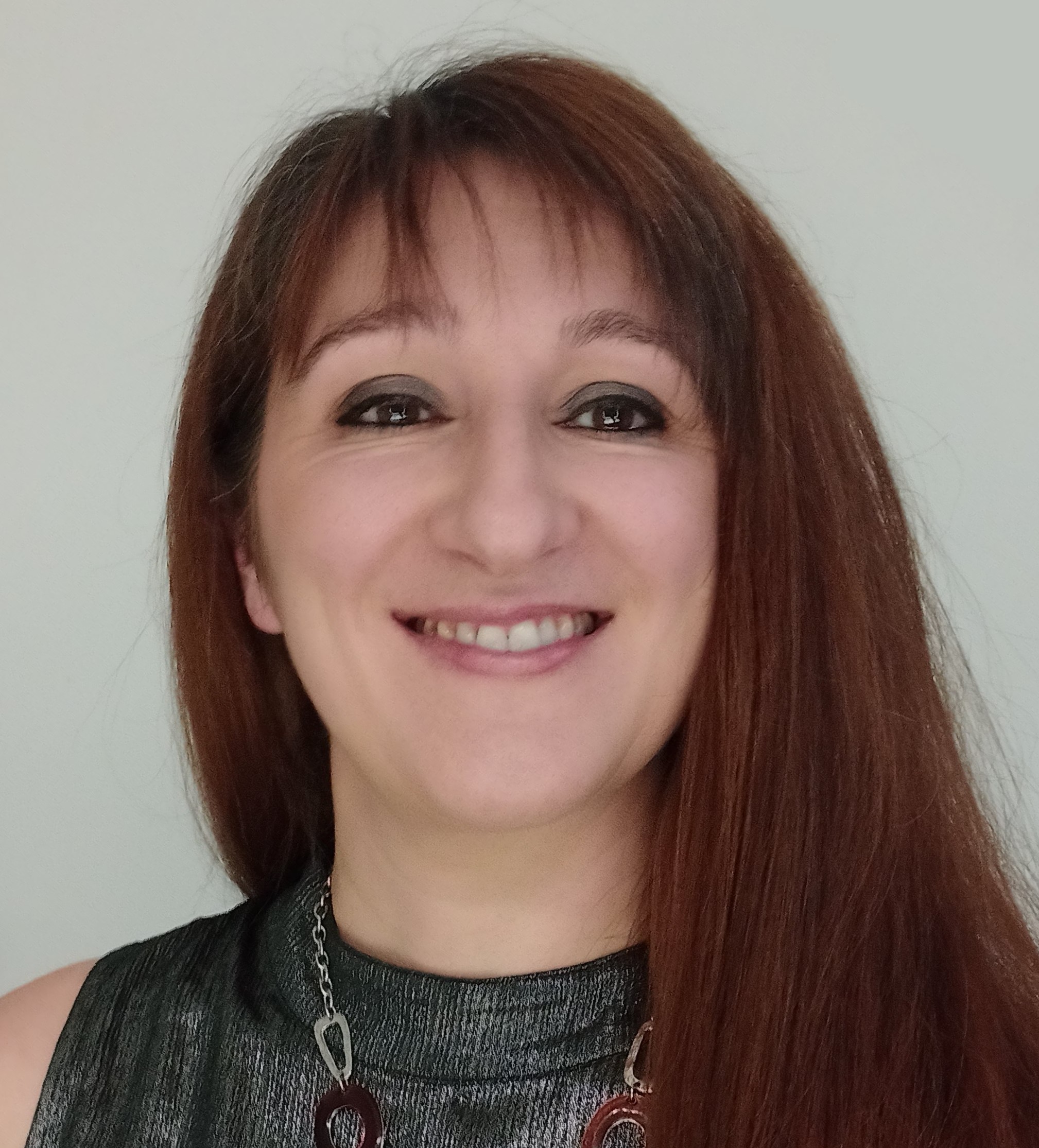
Dr Enrica Alasonati
WP3 leader, LNE
Senior scientist at LNE, with expertise in nanoparticle characterisation, field-flow fractionation, method validation and metrology for measurements in complex biological matrices.
Organisations contributing materials, methods or interlaboratory evidence to WP3
Matrix design, model nanomedicines, analytical methods and cross-laboratory comparisons brought together metrology institutes, research organisations, universities and industrial partners.


